Reuse & Refill Under SB 54: Meeting California’s Reuse Targets
California's SB 54 establishes ambitious source reduction goals for plastic packaging. While much of the attention has focused on recyclability, reporting, and EPR fees, another requirement deserves a moment in the spotlight: reuse and refill.
For many consumers, reusable packaging evokes nostalgic memories of returnable milk bottles or refillable beverage containers. For packaging engineers and supply chain professionals, however, it represents something far more complex—a fundamental shift in how products are designed, distributed, collected, and recovered.
With SB 54 bringing reuse and refill into the regulatory landscape, many organizations are beginning to ask the same questions: What exactly does the law require? Which products are good candidates for reuse? And where should companies begin?
What Does SB 54 Require?
California has established statutory targets requiring a growing share of plastic source reduction to come from reusable and refillable packaging systems. These targets increase over time, making reuse an increasingly important part of the state's broader source reduction strategy.
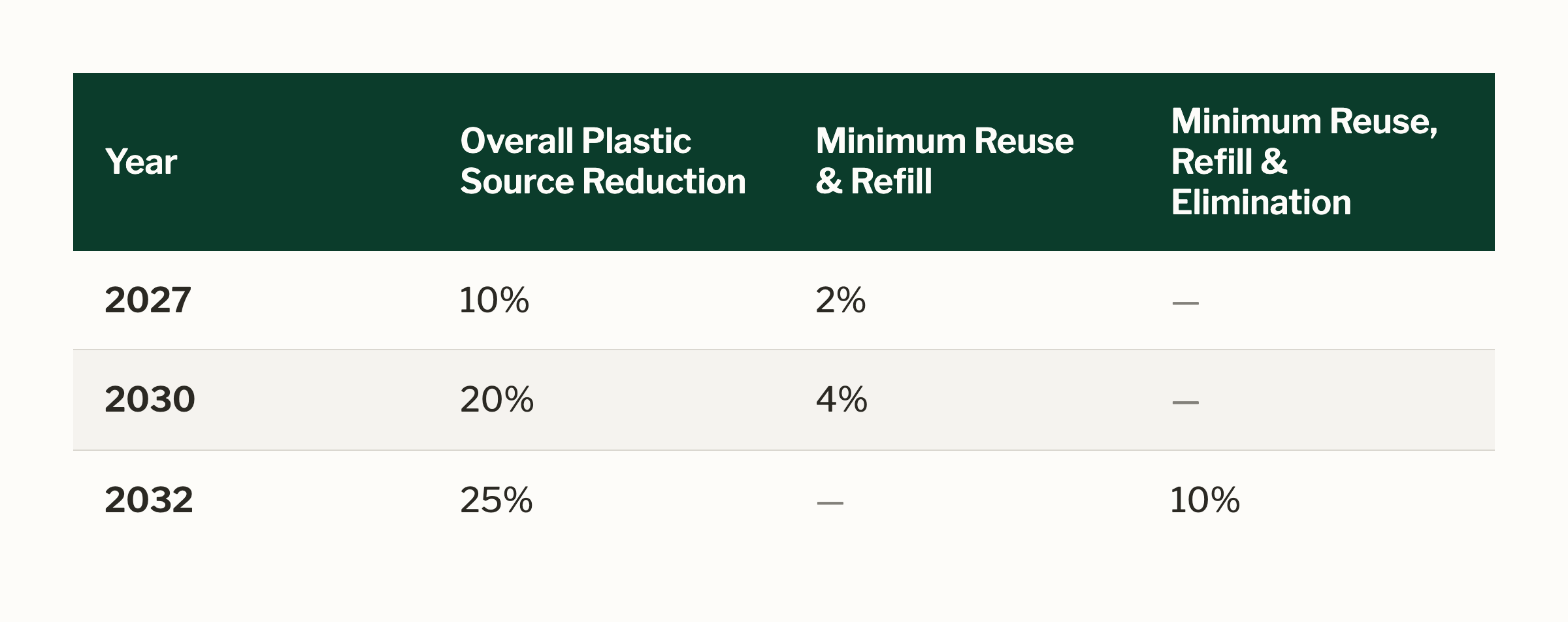
California's statutory targets apply at the program level, not to each producer individually. Under SB 54, the targets are measured based on the collective performance of producers participating in the program administered by the Circular Action Alliance (CAA), rather than requiring every producer to achieve the same percentage of reuse within its own packaging portfolio.
That distinction is important. Some organizations will have significant opportunities to implement reuse and refill systems, while others may face legitimate technical, food safety, or operational constraints. Collectively, however, the producer community must still identify and implement enough reuse opportunities to achieve California's statutory targets.
This raises an important question: where will California's reuse reductions come from?
Recognizing the scale of this transition, Circular Action Alliance's California Program Plan includes a dedicated Reuse and Refill Investment Plan focused on developing the infrastructure, partnerships, and funding needed to support reuse at scale. The Program Plan recognizes that successful reuse systems extend well beyond packaging design. Collection systems, reverse logistics, cleaning, retailer participation, consumer adoption, and supporting infrastructure all influence whether a reuse model can succeed commercially.
For producers, this represents an opportunity to begin evaluating where reuse fits within their packaging portfolio. For some organizations, that may include refillable consumer packaging. For others, reusable transport packaging, concentrated product formats, bulk dispensing systems, or new distribution models may offer greater potential. As California's program evolves, identifying these opportunities will be an important part of the industry's transition toward a more circular packaging economy.
Where Are the Opportunities?
California's reuse targets will require deliberate investment in new systems, infrastructure, and business models. Success will depend on coordinated efforts across producers, retailers, logistics providers, and consumers to create reuse systems that are both practical and commercially viable.
When evaluating opportunities, producers should think beyond the traditional image of a refillable consumer bottle. Reuse can take many forms, including consumer-facing packaging, business-to-business transport systems, concentrated products, and bulk dispensing models.
Consumer Packaging
Some product categories are naturally better suited to refill and reuse than others. Products that are purchased frequently, consumed at a predictable rate, and require limited cleaning or preparation often present the greatest opportunity.
Examples may include:
- Household cleaning products
- Laundry detergents
- Personal care products such as shampoos and soaps
- Beverage containers
- Dry pantry goods
- Pet food and treats
Business-to-Business Packaging
Some of the largest opportunities may exist outside the consumer's view.
Closed-loop supply chains often make reusable packaging far easier to implement because packaging moves between known locations and can be collected, inspected, and returned for repeated use.
Examples include:
- Reusable pallets
- Plastic totes and crates
- Intermediate bulk containers (IBCs)
- Ingredient bins
- Returnable transport packaging
- Food service delivery containers
- Reusable produce crates
For organizations supplying retailers, distributors, manufacturers, or food service operators, these systems may represent practical opportunities to reduce single-use packaging while maintaining operational efficiency.
Product Redesign
Product redesign can be just as important as packaging redesign when evaluating reuse opportunities. Concentrated formulations, bulk formats, and refill systems can all reduce the need for new packaging over time.
Examples include:
- Concentrated formulations requiring smaller refill packs
- Bulk formats for commercial customers
- Refill pouches used in conjunction with durable primary containers
- Subscription or take-back models
- Packaging designed for multiple trips through a distribution network
What Makes a Strong Candidate for Reuse?
One of the biggest misconceptions about reuse is that it begins with the package. In reality, successful reuse systems are usually built around products, customers, and supply chains that can support repeated use.
While every portfolio is different, the strongest opportunities often share several common characteristics.
Repeated Purchases
Products that consumers or businesses purchase regularly create natural opportunities for refill and reuse. Frequent purchasing reduces the time between refill cycles and helps establish repeat behaviors.
Closed-Loop Distribution
Reuse is often easier to implement when packaging moves through known locations and can be reliably recovered. Business-to-business supply chains, food service operations, and direct-to-consumer subscription models often provide greater control over package recovery than traditional retail channels.
Durable Packaging
Packaging designed to withstand multiple handling cycles is naturally better suited to reuse. Durability should be considered alongside the environmental impacts of producing a more robust package and the number of trips required to offset that impact.
Efficient Recovery
Collection is often the deciding factor between a successful reuse system and an unsuccessful one. The ability to recover, inspect, clean, and redistribute packaging efficiently has a significant influence on both environmental performance and commercial viability.
Product Compatibility
Some products are simply better suited to reuse than others. Household cleaners, detergents, and personal care products may transition more readily to refill systems than products requiring sterile packaging, high-barrier protection, or short shelf lives.
Customer Experience
Even the most technically sound reuse system depends on consumer or customer participation. Convenient return options, intuitive refill processes, and clear communication all influence adoption and long-term success.
Evaluating Your Portfolio
Rather than beginning with the question, "Which package could become reusable?", organizations may achieve better results by stepping back and evaluating the broader system.
Questions worth asking include:
- Which products are purchased frequently?
- Which customers already return packaging or operate closed-loop supply chains?
- Where do we already recover packaging today?
- Which packages are durable enough for multiple use cycles?
- Could concentrated formulations reduce the amount of packaging required?
- Are there opportunities to test a refill or return model with a limited product range?
- What infrastructure or partnerships would be needed to make a reuse system successful?
The answers will look different for every organization. The objective is to identify where reuse can provide meaningful environmental benefits while remaining technically, operationally, and commercially viable.
Looking Ahead
California's reuse targets represent more than another compliance requirement—they represent a shift in how packaging systems will be evaluated over the coming decade.
For some organizations, the opportunities will be obvious. For others, they may be more difficult to identify. Either way, now is the time to begin the conversation. Waiting until reuse targets become more prominent in reporting, fee structures, or program expectations may leave organizations with fewer options and less time to evaluate meaningful alternatives.
The answer is unlikely to be a single breakthrough package or a one-size-fits-all solution. Progress will come from thousands of individual decisions made across industries, products, and supply chains. Some will involve refillable consumer packaging. Others will focus on reusable transport packaging, concentrated products, bulk dispensing systems, or entirely new distribution models.
The organizations that begin exploring those opportunities today will be better positioned to adapt as SB 54 evolves—and to help shape the next generation of more circular packaging systems.
About the Author:
Nina Leatherday, Principal Consultant, Manager - EPR
Specializing in Food, Beverage & CPG, with 12 years of packaging development and leadership experience primarily in the food industry. She brings global experience across three continents, having served as Senior Packaging Engineer at Kraft Foods in New York (working on Crystal Light, Capri Sun, and Maxwell House Coffee packaging), Senior Packaging Technologist at Campbell Arnott's in Sydney (supporting one of Australia's most beloved cookie brands), and Packaging Team Manager at Kimberly Clark Australia. A Michigan State University graduate, Nina is known for her strength in cross-functional collaboration, data management, and process development.