California SB 54 Illustrative Fees Are Out. Read Them as a Design Brief, Not a Tax Bill.
.png)
On May 1, 2026, the Circular Action Alliance (CAA) published its California Illustrative Fee Schedule for SB 54. These are not the final fees. CAA expects them to change before the final program plan goes to CalRecycle in October.
But there is a more useful way to read them than as a budgeting exercise. The fee structure itself signals which packaging formats SB 54 is going to make expensive, and that signal is not going to flip between now and October. Producers who treat the schedule as a design brief, rather than a line item to forecast, will be in a much stronger position when the real invoices arrive.
The Takeaway: The relative ordering of fees across packaging formats is reliable, even though the dollar amounts are not. Design against the ordering. Budget against the range.
How the Fee Stack Works:
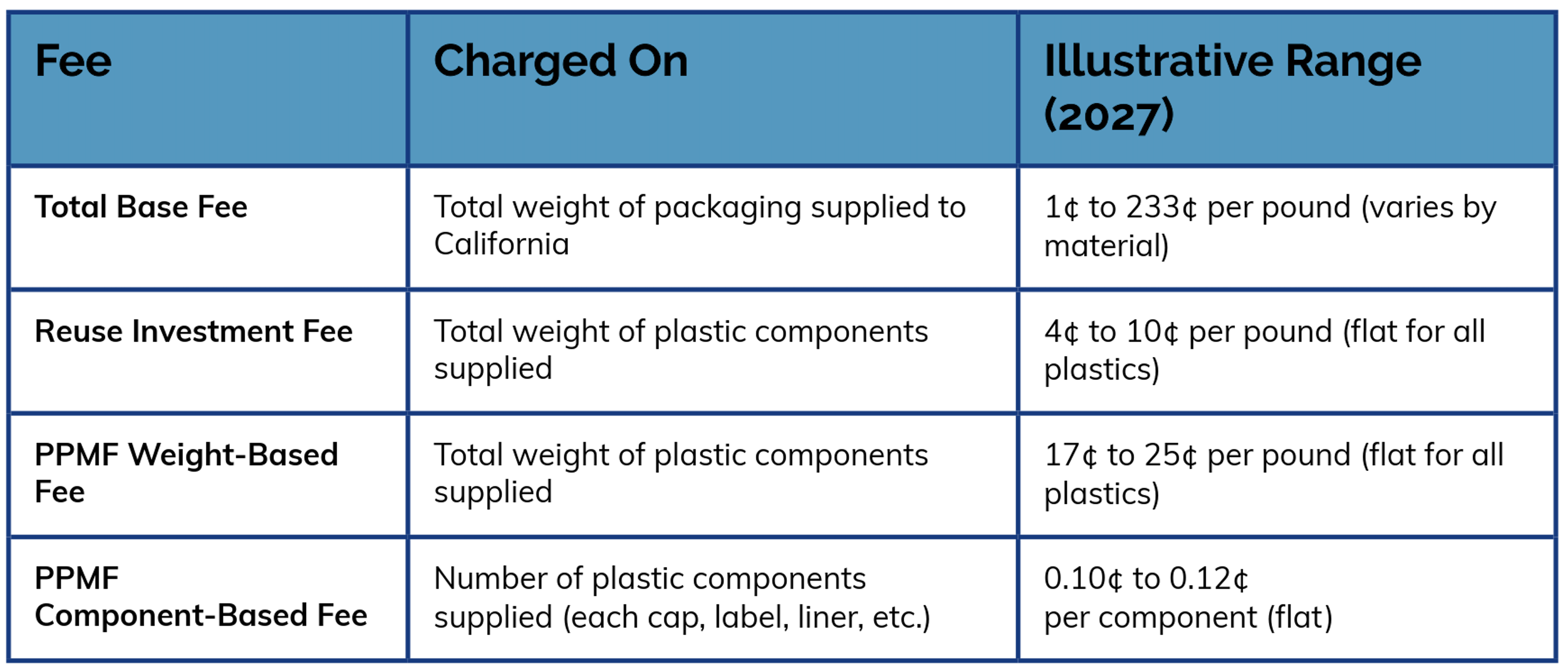
1. Total Base Fee. This is the main program fee. It covers everything CAA needs to run the SB 54 program: collection, sorting, processing, end-market investments, education. The rate changes by material category, which is why glass bottles cost a fraction of a cent and PVC film costs over a dollar a pound.
2. Reuse Investment Fee. A separate pool that funds reuse and refill programs. Charged on plastic only. Same rate for every plastic format.
3. PPMF Weight-Based Fee. California's Plastic Pollution Mitigation Fund (PPMF) is a $500M/year statutory pot. CAA has to collect it on top of the program fees. 80% of that pot is charged based on plastic weight. Same rate for every plastic format.
4. PPMF Component-Based Fee. The remaining 20% of the PPMF pot is charged per plastic component (per cap, per liner, per label, etc.). Same rate for every plastic component.
Three of the four fees are flat across all materials. Only the Total Base Fee changes by material. Here's how the math gets applied:
Quick definition: "Supplied" means everything a producer puts into the California market in a year. "Component" means an individual piece of packaging, like a bottle, cap, label, or seal. A single SKU usually has multiple components.
Because three of the four fees are flat across plastics, material choice only changes the Total Base Fee. That's where the design decisions matter, and the spread is dramatic.
Three Fee Signals worth Acting On
1. Foam is the most expensive plastic on the schedule. Expanded polystyrene (EPS) foam containers, plates, cups, and trays come in at 47¢ per pound in the low scenario and 127¢ in the high scenario. PET clear bottles run 11¢ to 35¢. Foam costs three to four times more per pound than rigid PET, before the PPMF fees stack on top. If foam is still in your portfolio, the redesign business case just got written for you.
2. Multi-material laminates and pouches get hit hard. Laminate pouches and envelopes land at 59¢ to 149¢ per pound. PS flexible film hits 70¢ to 179¢. PVC flexible reaches 69¢ to 176¢. The lightweighting story that made pouches popular over the last decade is now competing with a fee several times what a PET bottle pays. Categories that switched from rigid to flexible to chase weight savings should re-run that math.
3. The per-component fee quietly punishes complexity. 0.10¢ to 0.12¢ per component sounds tiny, but it adds up fast. A package with a bottle, cap, induction seal, neck band, and label is five components. Across hundreds of millions of units, that's real money. There's a reason the fee works this way: each component often falls into a different material category, which means it has to be tracked, sorted, and processed separately. More components, more system cost. The fee structure passes that cost back.
Why This is the Same Project as Source Reduction
SB 54 also requires producers to cut total plastic packaging weight by 10% (against a 2023 baseline) by January 2027, and 25% by 2032. The same lever (less plastic, fewer components, simpler designs) lowers fees AND hits the source reduction target. A pouch coming out of the portfolio reduces source reduction baseline weight and drops a high-fee SKU. Cutting components from five to three lowers the per-unit PPMF fee and counts toward the 2027 target. Producers running these as two separate projects are paying for the work twice.
What to Do this Quarter
The regulations went final on May 1, which started a fast clock. In order: - Get your 2025 supply data to CAA. The 2026 Producer Report and Annual Source Reduction Report are due to CAA by May 31, and producer registration plus supply data submission is due June 1. If suppliers still owe you component weights or material breakdowns, today is the day to chase them.
- Run your portfolio against the illustrative fee schedule. Apply both the low and high scenario to your California supply numbers. The output is a heat map showing which SKUs drive the most fee load. Sort by fee, not by volume. A low-volume EPS tray can carry more fee per unit than a high-volume PET bottle.
- Build the source reduction plan and the fee model together. Individual Source Reduction Plans are due August 1. They look at the same SKUs as the fee model. If they're being built by separate teams in separate spreadsheets, you're doubling the work and probably missing the synergies.
The Bottom Line
The illustrative fees are a preview of which packaging decisions California is going to make expensive. The preview is specific enough to design against. Final fees come in October, but the relative ordering of formats is locked in now. Producers who model the exposure today, and pull it into the same conversation as their source reduction work, will be ahead when the real invoices land.
Contact us today to model your SB 54 fee exposure or align your source reduction plan with your fee strategy.
Disclaimer: Informational only; not legal advice.