From Fragmented to Formalized: How a Fortune 500 Retailer Built a Packaging Sourcing Standard

Every large retailer that sells its own brands eventually runs into the same quiet problem. The packaging programs that came first grow disciplined and well governed. The newer, faster-moving categories are left to improvise. Before long, there is not one packaging operation but several, each with its own rules, its own suppliers, and its own blind spots.
Another checklist rarely fixes that. What does work is a structured read of how the organization actually operates today, an honest comparison against how the best companies in the industry operate, and a realistic sequence for getting from one to the other.
That is exactly what a Fortune 500 retailer engaged Adept Group to deliver across its owned-brand packaging portfolio. The client is not named here and identifying details have been generalized, but the method is reproducible, and the method is what matters.
The Challenge: One Retailer, Two Speeds
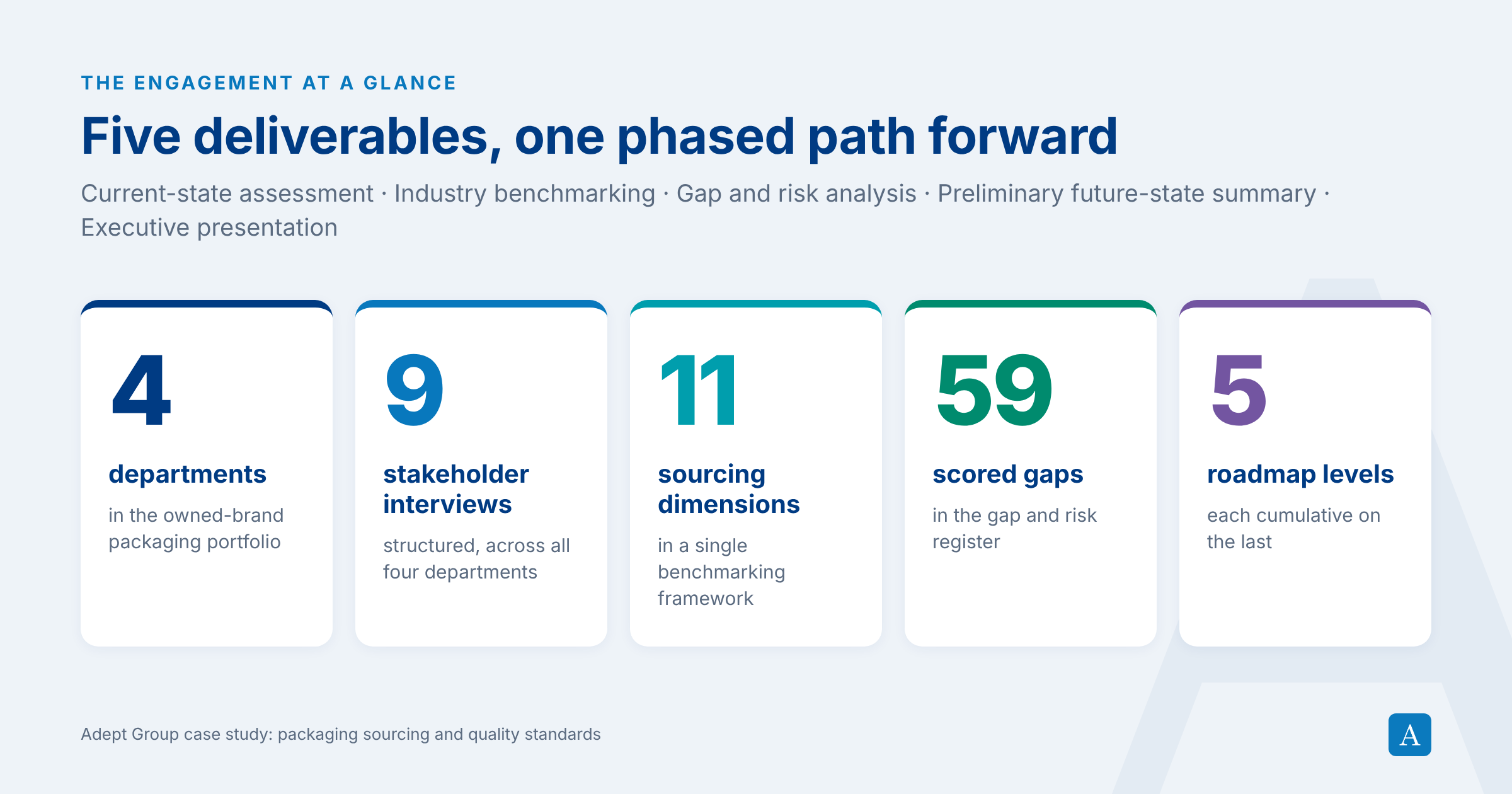
The client manages owned-brand packaging across four large departments. Two of them, apparel and home, were long-established programs with real maturity: enforced supplier certification, retailer-owned specifications, negotiated pricing, and layered quality verification. The other two, food and beverage and the essentials, beauty, and pets group, commercialize an enormous volume of new products every year, yet operate with materially less formal structure.
The leadership team that owns and funds packaging sourcing put the central question plainly: what will it take, and where are the gaps, to run packaging sourcing for the newer departments as maturely as the established ones?
That question is harder than it looks. The mature departments are built mostly around paper and board, where certification pathways are well defined. The newer departments carry a very different material mix, heavy in plastics, films, and food-contact and cosmetic formats, where the established model does not simply lift and shift. Add two overlapping internal frameworks for describing categories, inconsistent vendor terminology, and critical institutional knowledge living in individual engineers' heads rather than in any system, and the first job was clear: understand all of it before recommending anything.
The Pivot: Regrounding on the Sourcing Lens
The most instructive moment came right after our first major deliverable. When we presented the current-state assessment to the client's full cross-functional group, the feedback was candid: the analysis went too deep on packaging design and development and not deep enough on sourcing. The team that owns and pays for the work needed a hard focus on supplier qualification, designation, negotiation, audit cadence, cost governance, and the regulatory programs behind them.
We treated that not as a scope change but as a regrounding. Within the same week, we restated the thesis in the client's own words, reframed the deliverable around the sourcing lens while keeping the structure they valued, corrected vendor terminology across every document, and built a shared glossary so language would never again be a barrier.
We also named and closed our own biggest gap. Our initial discovery had leaned on the mature programs as a reference model rather than interviewing them directly, yet those programs are exactly where the real negotiation, supplier designation, vetting, and quality-on-arrival tracking live. Those teams sit overseas, so we added dedicated interviews with the regional leaders, offered a written Q&A fallback for time-zone constraints, and put a commodity-independent sourcing subject-matter expert on the calls. The reset did not slow us down. It made every subsequent deliverable sharper.
Building the Current-State Baseline
A credible future state has to rest on an honest current state. Our baseline drew on three layers of evidence gathered during the first month of discovery:
- Nine structured stakeholder interviews spanning supplier onboarding, sourcing leadership, and packaging engineering across all four departments
- A direct review of the client's internal vendor-training and structural-packaging requirement documents
- An internal working session with client leadership that clarified terminology and surfaced the single most important finding of the assessment
We organized what we heard into a maturity snapshot across six recurring dimensions, framed deliberately as a read of the current state, not a scorecard of any team's performance.
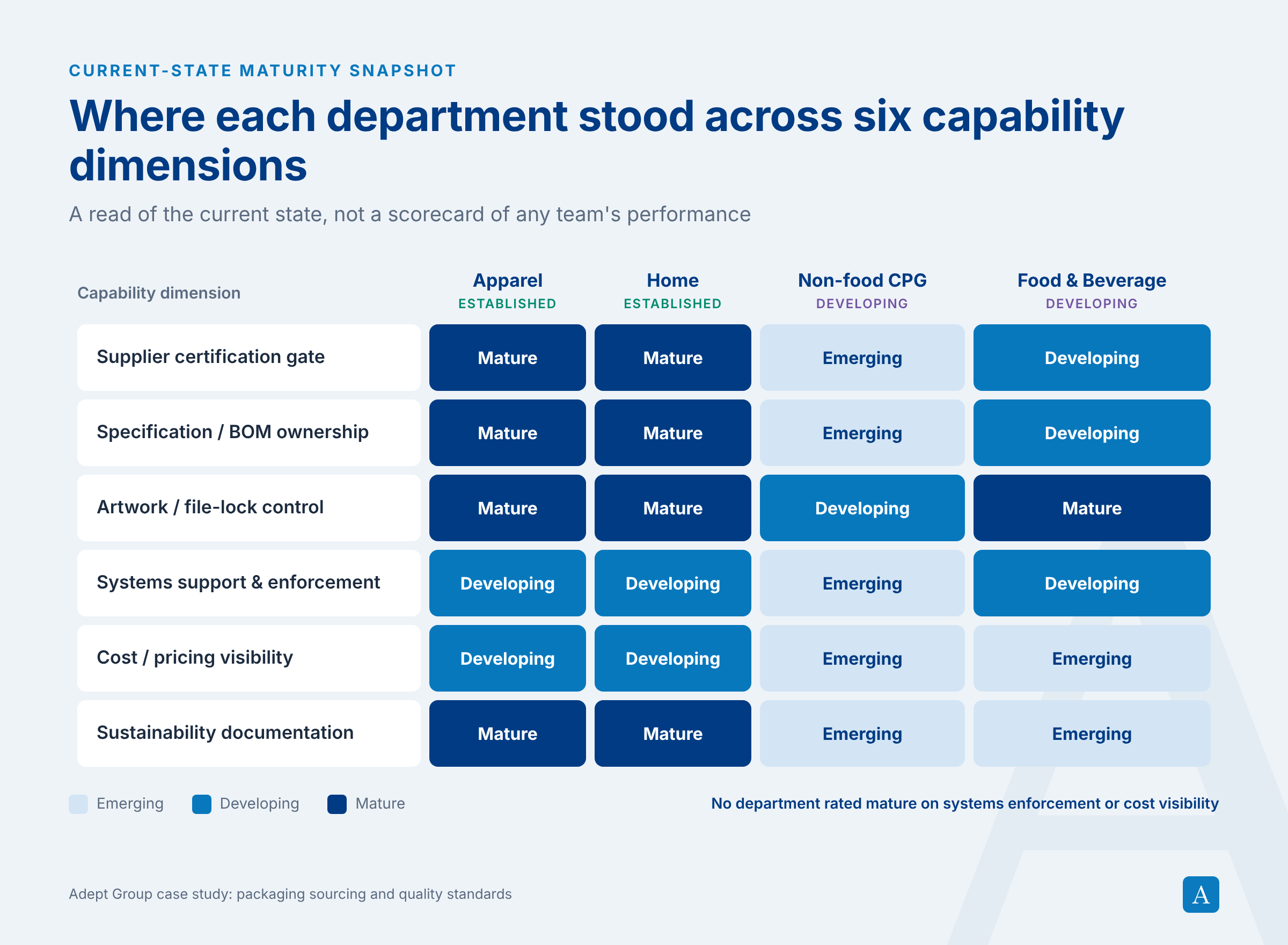
The pattern was clear. The two established departments clustered at the high end across nearly every dimension, while the two developing departments trailed almost everywhere. Just as important, no department rated mature on systems enforcement or cost visibility. Those were portfolio-wide gaps, not the failing of any one group.
The root cause: Who owns the specification
The real value of the assessment sat beneath the snapshot. Rather than present a flat list of sixteen separate problems, we organized the findings into tiers and traced each symptom back to its source.
The single upstream condition: wherever the retailer owned the packaging specification, it had the leverage to certify suppliers, direct pricing, and capture savings. Wherever the co-manufacturer developed and controlled the specification, that leverage largely disappeared. Thin visibility into packaging suppliers, unverified cost-savings pass-through, uneven certification, and fragmented regulatory ownership were not independent issues. They were downstream consequences of who owned the specification.
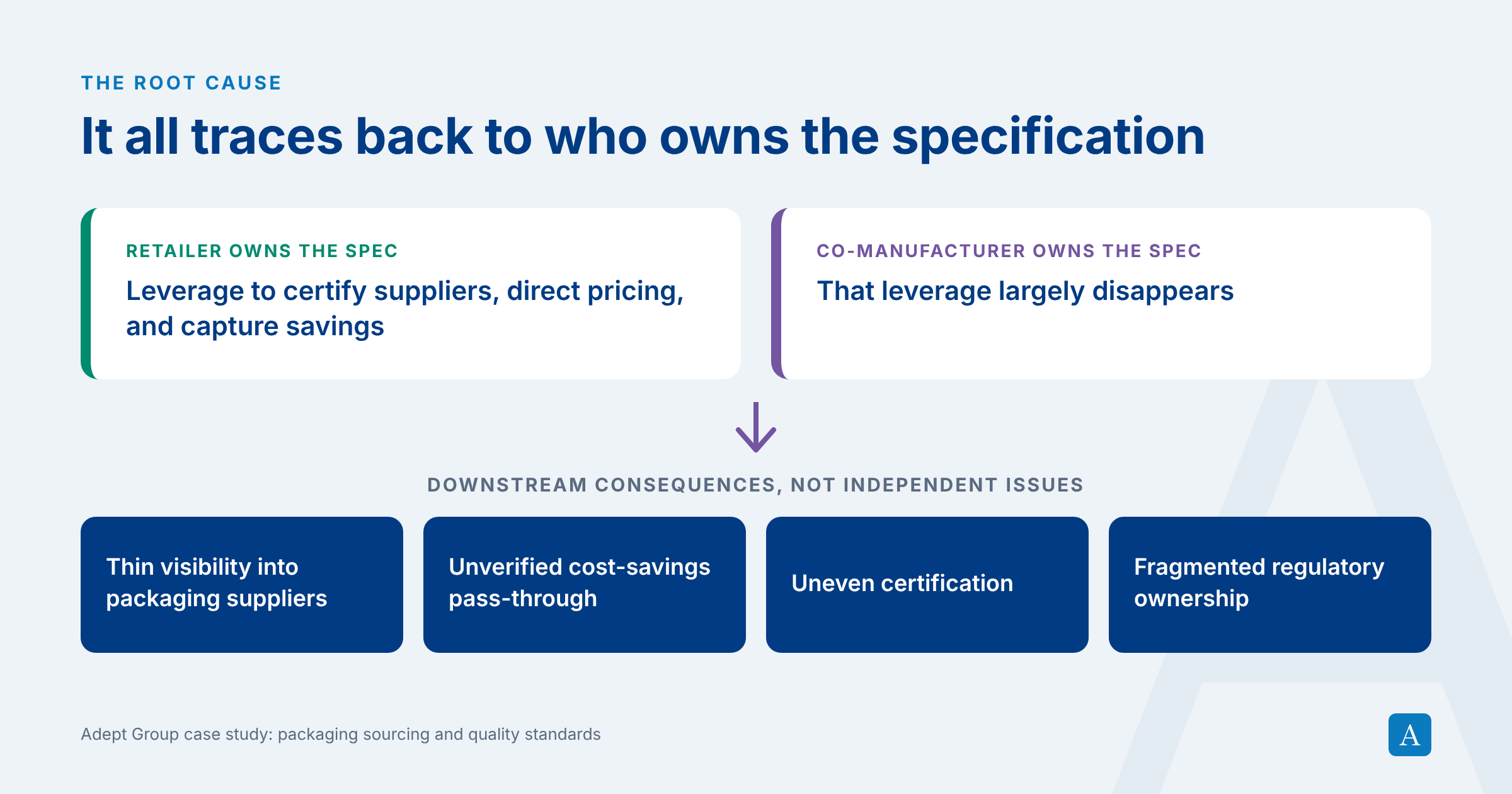
That reframing changed everything that followed. Specification ownership could not be treated as one gap among many; it had to be understood as the primary lever.
Benchmarking Against the Best
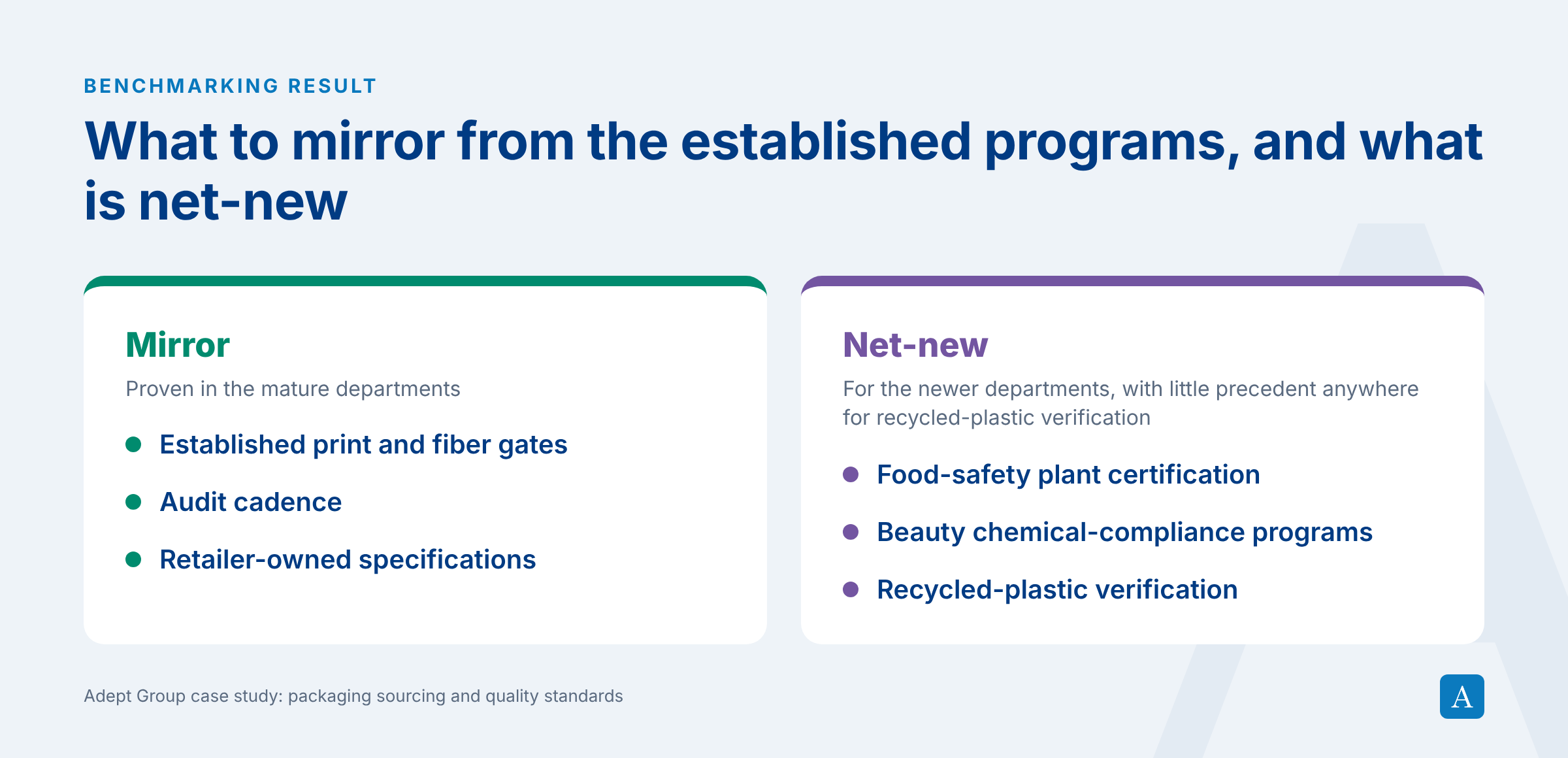
With the baseline set, we turned outward to answer a practical question: which practices that make the mature departments work can be mirrored into the developing ones, and which are genuinely net-new because the material mix and regulatory environment are different?
We built a single framework of eleven sourcing dimensions, covering the full sourcing lifecycle rather than sustainability alone, and assessed every comparator against the same skeleton.
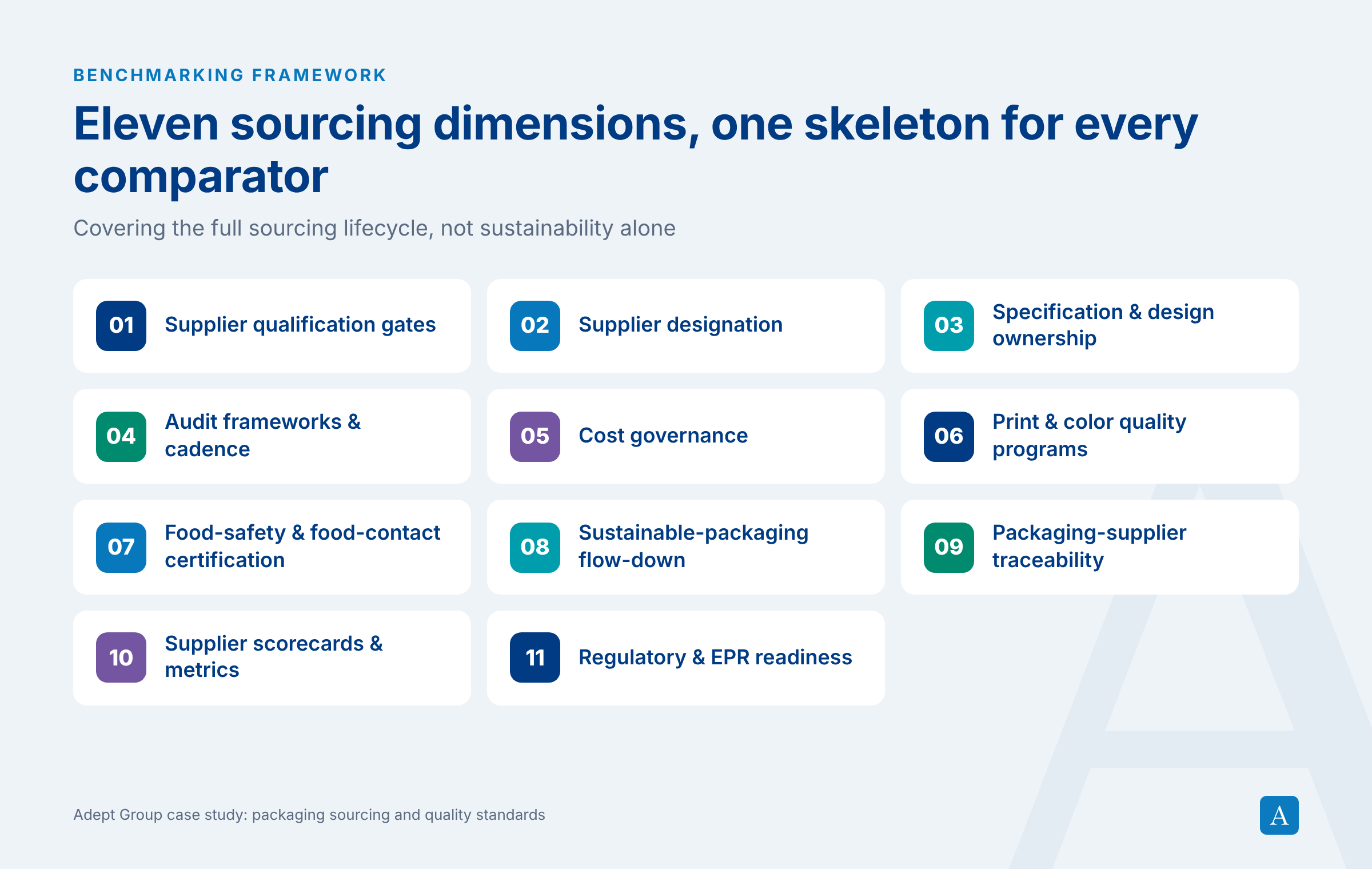
The comparator set was deliberately broad: leading grocery and mass retailers with strong owned-brand programs, plus major global consumer packaged goods companies spanning food, household, beauty, and personal care. We paired that with a full read of the certification and standards landscape, from fiber chain-of-custody and print certification to food-safety schemes, chemical-compliance regimes for beauty, recycled-content verification, and social-compliance audit frameworks.
One honest constraint shaped the phase. Sustainability requirements and social-audit frameworks are heavily public, but the commercial mechanics that matter most to sourcing (should-cost modeling, negotiation calendars, the economics of supplier designation, and scorecard enforcement) are almost entirely confidential across every peer. We were transparent about that split and filled the confidential gaps through our own sourcing subject-matter experts and the client's established overseas leads.
The headline finding: One national grocery retailer stood out as the closest analog to what the client wanted to build. It designates specific packaging suppliers, retains control of all packaging specifications, publishes fixed artwork and quality-management fee schedules, and enforces standards through per-item defect penalties and printer scorecards. In other words, it combines designation, owned specifications, and enforcement in one model, which is exactly what the client already does in its mature departments and wants to extend.
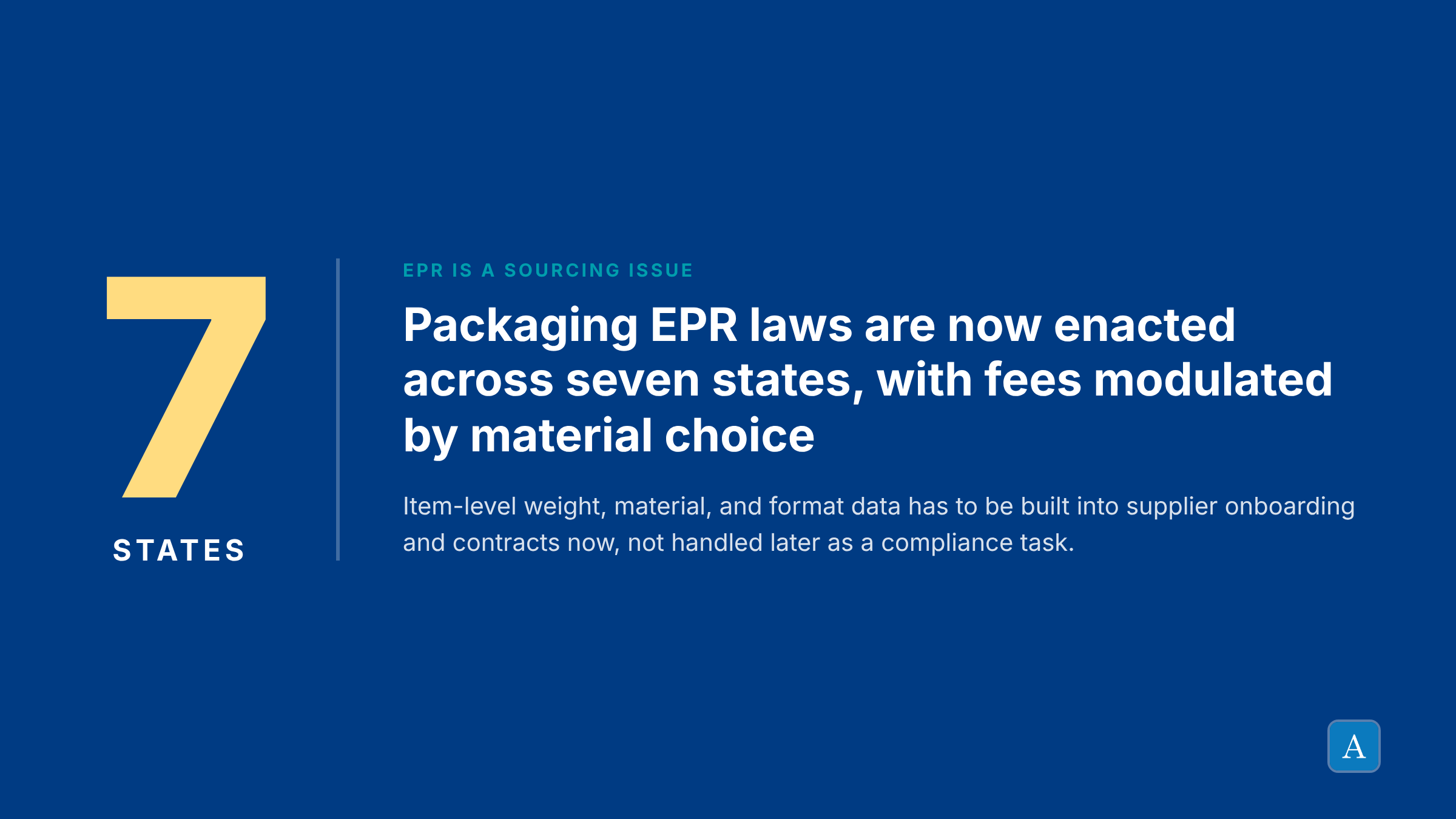
We also reframed extended producer responsibility (EPR) from a reporting chore into a sourcing issue. With packaging EPR laws now enacted across seven states and fees modulated by material choice, the same product costs more to sell if its packaging is non-recyclable, multi-material, or low in recycled content. That makes item-level weight, material, and format data a sourcing requirement to build into supplier onboarding and contracts now, not a compliance task for later.
The Rhythm That Kept It on Track
A compressed timeline that absorbs a mid-course regrounding without missing a single deliverable date does not happen by accident. Four practices held it together:
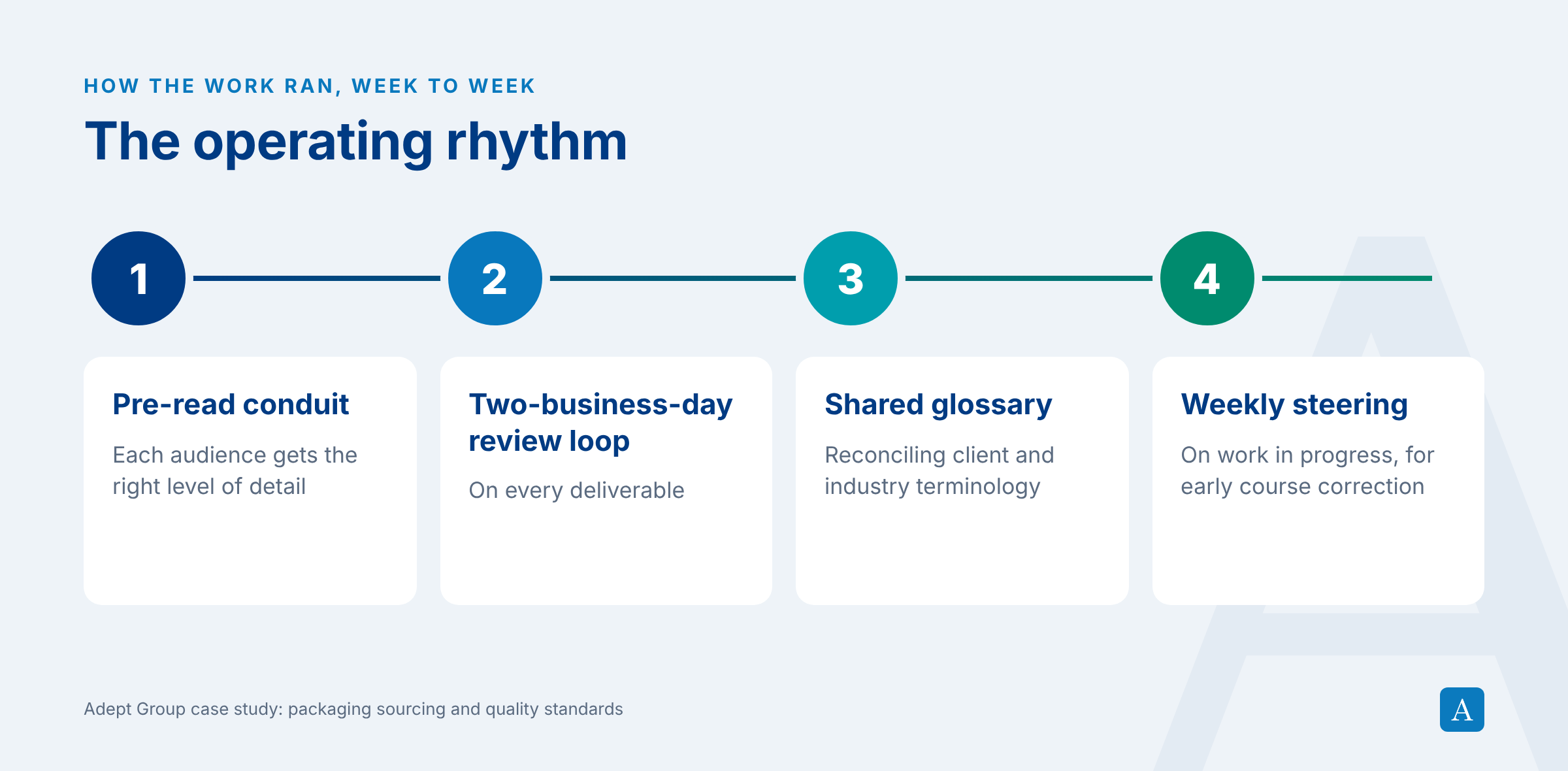
- Pre-read conduit: the two client sourcing leads received detailed report-outs first and filtered them before anything reached the wider group, so every audience got the right level of detail.
- Two-business-day review loop: we delivered, the leads reviewed within two business days, we incorporated within a couple more, and only then did material go to a leadership session.
- Shared glossary: client-specific terms flagged against industry terms, so language never became the obstacle it briefly had been.
- Weekly Monday steering: work in progress, not presentation-ready polish, so the client could course-correct early rather than at the deliverable gate.
Behind the scenes, drafts went through internal cross-path alignment before reaching the client, and risks and blockers were flagged within a day of being identified.
From 59 Gaps to a Five-Level Roadmap
The gap and risk analysis turned benchmarking into a scored register: fifty-nine gaps, each rated for risk so the organization could see not just what was missing but what was most urgent.
Rather than hand over a wish list, we built a five-level engagement roadmap that sequences those gaps into a logical build order, with each level cumulative on the last. It was refined directly with the client's stakeholders, including a deliberate choice to position specification documentation as the unlock for negotiation and designation.
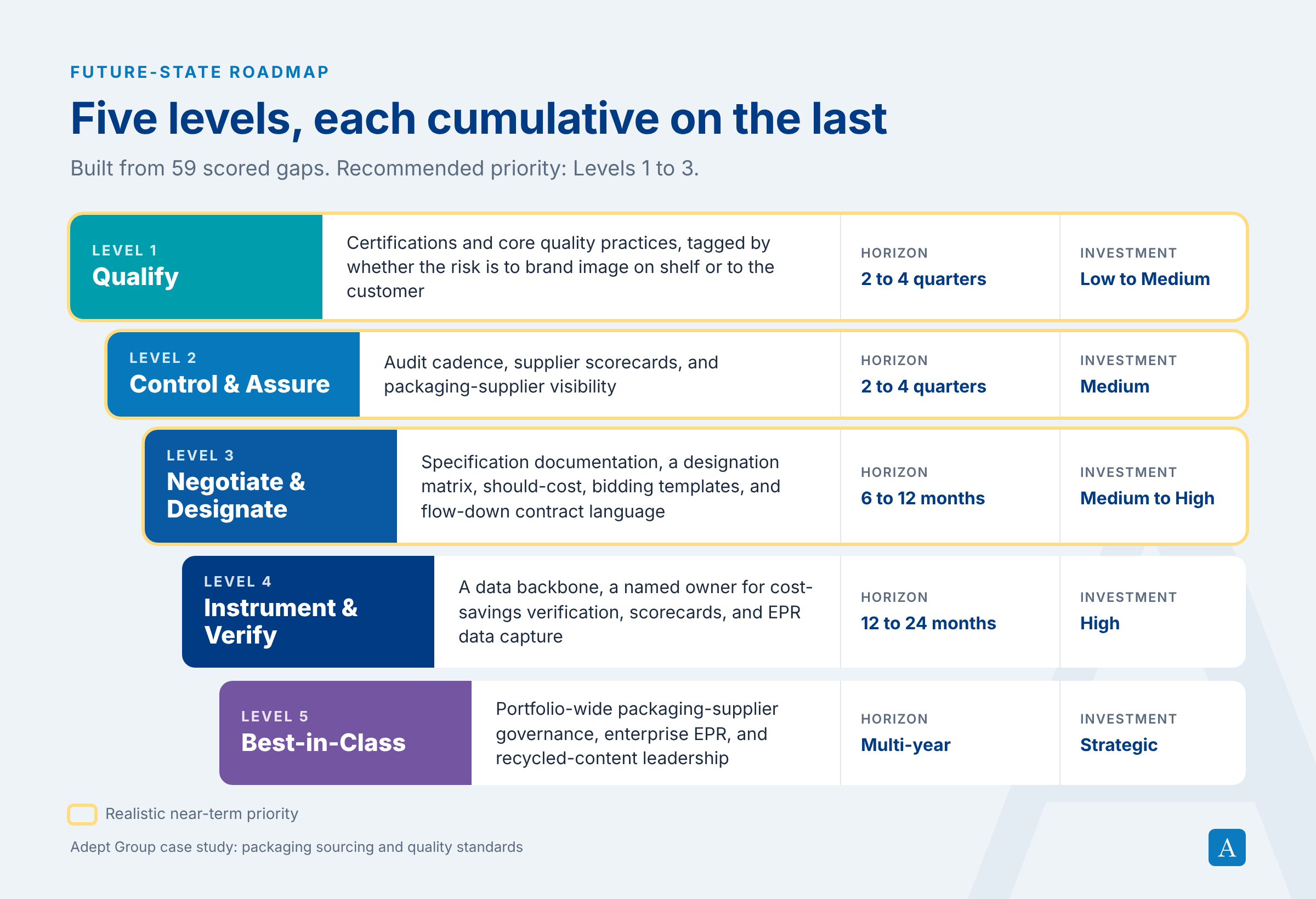
Our recommendation: treat all five levels as the roadmap, but realistically prioritize the first three. Those deliver what the client most needs: confirmed quality through qualified packaging suppliers, a working compliance and assurance process, and, once specification documentation is owned, the visibility that makes negotiation and designation possible at all. The data backbone follows, while long-timeline enterprise items like a single owner for EPR and recycled-plastic leadership begin in parallel.
The roadmap works because it is anchored to the root cause. It does not try to fix visibility, cost governance, and certification as isolated projects. It sequences them so each level earns the leverage the next one depends on.
Why It Matters
Stripped of its specifics, this engagement shows a repeatable capability. Adept Group learned a large, genuinely complex retail organization from the inside, across four departments, multiple regions, and two overlapping internal frameworks, quickly enough to be useful. We benchmarked it against the best public and expert-sourced practices in the industry and were honest about where the public record ran out. We found the structural root cause beneath a long list of symptoms. And we turned all of it into a phased, risk-rated roadmap a cross-functional leadership team could actually act on.
Just as telling is how we handled the moment the client asked us to change course. We regrounded without losing time, named and closed our own gaps, and came back sharper. That is the difference between a vendor who delivers a report and a partner who delivers a result.
Facing the same fragmentation? To discuss a packaging sourcing, quality-standards, or benchmarking challenge in your organization, reach out to the Adept Group team at inquiry@adeptpackaging.com.