The Hidden Cost of Packaging Design Trade-Offs (and How to Quantify Them)

March 25,2026
Category: Sustainability
Most packaging trade-offs look obvious... until you quantify them.
And that's the real issue: packaging design decisions rarely fail because and engineer "got it wrong". They fail because the trade-off math was incomplete. For years, teams could afford to make smart, experience-based calls like: "this should reduce cost, improve recyclability, reduce weight".
That kind of judgment worked when the packaging ecosystem was more forgiving. But in 2026 and beyond, EPR programs and recyclability mandates are turning "should" into measurable financial exposure. If you c
an't see the full trade-off, you can't defend the decision. Especially when finance, sustainability, and leadership are all asking for the "why".
What's changed is not that engineering teams got worse at packaging. It's that the packaging ecosystem has become more complex, and the consequences have become more expensive.
EPR laws are expanding and getting more granular. Modulated fees, eco-modulation, and reporting requirements are increasing. And more stakeholders are now in the decision loop: engineering procurement, sustainability, finance, legal/compliance.
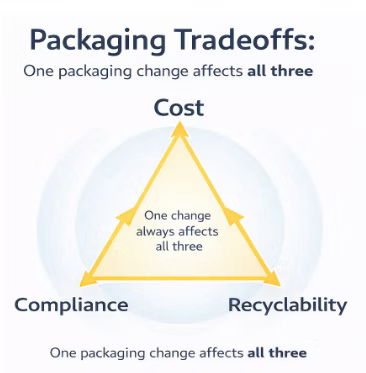
That means one packaging change can now ripple across all of the following at once: unit cost, EPR fees, recyclability outcomes, reporting complexity, and operational risk.
This is why "quick swaps" and "simple changes" don't stay simple. The decision isn't harder because engineers can't solve it; it's harder because the inputs and downstream impacts now span multiple system jurisdictions, and teams.
Given that complexity, it's worth naming the trade-offs that come up most often, and why each one is harder than it looks.
Examples: PET → rPET, multi-material → mono-material, paper substitution for plastic.
Why it's Tricky: Recyclability changes by region, supply costs fluctuate, and EPR fee impacts vary by material and format. A material that's "better" on paper can land very differently once you factor in regional sorting realities and fee structures.
Examples: Thinner film, downguaging, removing components (caps/liners/labels).
Why it's Tricky: Performance risk increases and damage/shrink can offset the savings. You might also improve recyclability while still increasing compliance complexity, depending on how that packaging is categorized and reported.
Examples: Adhesives, label material, barrier layers, closures.
Why it's Tricky: A "minor" change can break recycling compatibility, often isn't captured in early cost models, and can even change how packaging is classified under different EPR programs.
Each of these trade-offs shares a common thread: The surface-level decisions looks manageable, but the downstream math is harder to see. Which brings us to the cost that most teams miss.
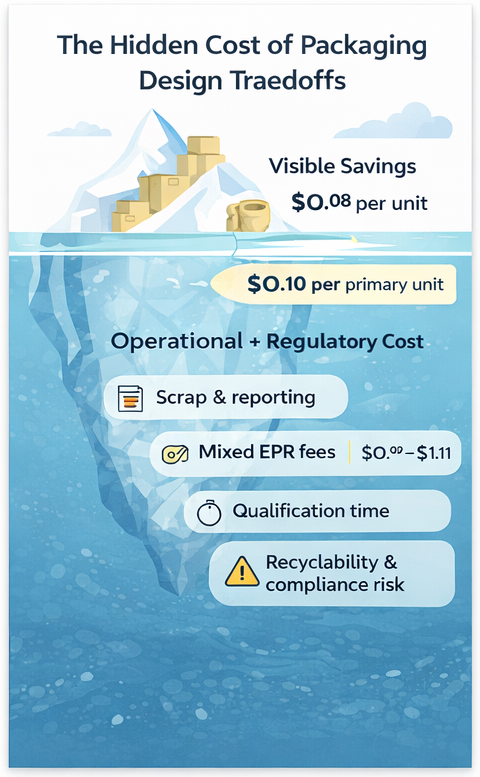
When teams say "cost", they usually mean unit price. But the real cost of a packaging change is bigger, and it typically shows up later, when you have the least time and most pressure.
Data lives in different places (ERP, spec sheets, sustainability docs, legal). The "right answer" depends on geography and policy. EPR data isn't easily accessible in engineering workflows. Recyclability guidance can be inconsistent. Cost modeling often ignores compliance. And teams don't have a shared decision framework.
In other words, the inputs that define "best" are scattered, and the decision criteria aren't aligned. That lack of visibility is a real source of fear for engineers, because without data, you're forced to choose the safest path, not the smartest one.
The good news is that you don't need a perfect system to start making better calls. You just need a consistent framework.
A simple framework: quantify trade-offs across 3 dimensions
Every packaging change should be evaluated through three lenses:
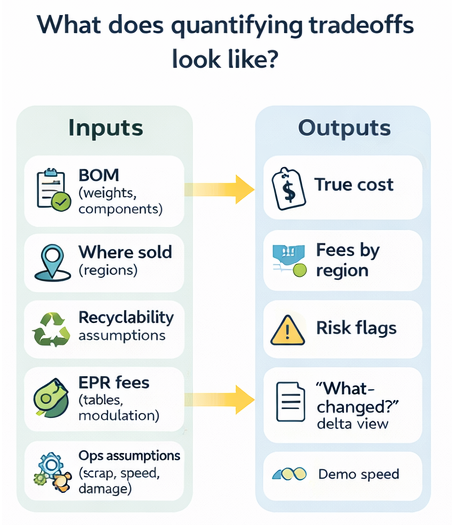
You don't need a perfect data warehouse to start. You need a minimum viable model, just enough structure to compare scenarios and see deltas clearly.
Minimum viable inputs:
Let's use a simplified example to show why "it should save money" is rarely the full story.
Scenario: You're considering switching from a multi-material pouch to a mono-material structure. On paper, it sounds like a win: improved recyclability, reduced fees, simpler messaging.
Now, let's quantify it at a hypothetical annual volume of 10,000,000 units (example only):
In this example, the headline might read "fees dropped in State A". But the full picture includes unit cost deltas, scrap during ramp-up, mixed fee outcomes across jurisdictions, and reporting complexity.
That's the point: the change isn't "good" or "bad". It's a trade-off, and you need the numbers to decide whether it's worth it. More importantly, you need those numbers before you're three weeks into a redesign cycle.
Packaging engineers who can quantify trade-offs don't just improve packaging. They improve decisions. They become the trusted advisor in the room, the person who can translate material, fee, and regulation trade-offs into clear, data-backed direction.
This capability helps teams reduce redesign churn, prevent compliance surprises, protect margins, and provide finance and sustainability with decision-ready inputs. This is how engineering shifts from "spec owner" to "strategic advisor". And in an environment where more stakeholders are involved in every packaging decision, that shift matters. My colleague, Timothy Waldron, wrote about this in-depth recently (How EPR Changed Packaging Engineering from Specs to Strategy), how EPR is shifting the role of packaging engineering.
The direction is clear: more jurisdictions, more eco-modulated fees, more reporting scrutiny, and less tolerance for "we didn't know".
Packaging decisions will increasingly require forecasting, scenario modeling, and auditability. The teams that build those muscles now, before they are mandated, will have a significant advantage over those playing catch-up.
Trade-offs are not the problem. Invisible trade-offs are the problem.
The lack of data is a real fear for engineers because it forces conservative decisions. The goal of quantification isn't to create more paperwork. It's to give engineers the visibility to make smarter, faster, and more defensible calls.
The teams that win in this next era will be the ones who can quantify cost, compliance, and recyclability together, because when you can model all three, you stop arguing opinions and start making decisions.
Attribution: Article images designed by Keshia Mack utilizing ChatGPT
About the Author: Keshia Mack is a Senior Packaging Engineer with 10+ years in CPG and food & beverage, specializing in packaging optimization, cost savings, and commercialization. PMP-certified leader skilled in cross-functional execution, supplier collaboration, and sustainable packaging innovation.
And that's the real issue: packaging design decisions rarely fail because and engineer "got it wrong". They fail because the trade-off math was incomplete. For years, teams could afford to make smart, experience-based calls like: "this should reduce cost, improve recyclability, reduce weight".
That kind of judgment worked when the packaging ecosystem was more forgiving. But in 2026 and beyond, EPR programs and recyclability mandates are turning "should" into measurable financial exposure. If you c
an't see the full trade-off, you can't defend the decision. Especially when finance, sustainability, and leadership are all asking for the "why".
Why This Problem is Getting Worse (Not Better)
What's changed is not that engineering teams got worse at packaging. It's that the packaging ecosystem has become more complex, and the consequences have become more expensive. EPR laws are expanding and getting more granular. Modulated fees, eco-modulation, and reporting requirements are increasing. And more stakeholders are now in the decision loop: engineering procurement, sustainability, finance, legal/compliance.
That means one packaging change can now ripple across all of the following at once: unit cost, EPR fees, recyclability outcomes, reporting complexity, and operational risk.
This is why "quick swaps" and "simple changes" don't stay simple. The decision isn't harder because engineers can't solve it; it's harder because the inputs and downstream impacts now span multiple system jurisdictions, and teams.
The Three Most Common Trade-Offs Engineers Make (and Why They're Hard to Evaluate)
Given that complexity, it's worth naming the trade-offs that come up most often, and why each one is harder than it looks.
Trade-Off A: Material Swap
Examples: PET → rPET, multi-material → mono-material, paper substitution for plastic. Why it's Tricky: Recyclability changes by region, supply costs fluctuate, and EPR fee impacts vary by material and format. A material that's "better" on paper can land very differently once you factor in regional sorting realities and fee structures.
Trade-Off B: Lightweighting
Examples: Thinner film, downguaging, removing components (caps/liners/labels). Why it's Tricky: Performance risk increases and damage/shrink can offset the savings. You might also improve recyclability while still increasing compliance complexity, depending on how that packaging is categorized and reported.
Trade-Off C: "Small" Component Change
Examples: Adhesives, label material, barrier layers, closures.Why it's Tricky: A "minor" change can break recycling compatibility, often isn't captured in early cost models, and can even change how packaging is classified under different EPR programs.
Each of these trade-offs shares a common thread: The surface-level decisions looks manageable, but the downstream math is harder to see. Which brings us to the cost that most teams miss.
The Hidden Cost Most Teams Miss
When teams say "cost", they usually mean unit price. But the real cost of a packaging change is bigger, and it typically shows up later, when you have the least time and most pressure. - Regulatory Cost — EPR fees (current + forecasted), reporting requirements, penalties and non-compliance risk, region-specific rule mismatches.
- Recyclability Cost — Recyclability score degradation, incompatibility with local recycling streams, brand/retailer requirements, forced redesign due to policy changes.
- Operational Cost — Line speed impacts, yield loss and scrap, damage rates, supplier qualification effort, changeover complexity.
- Time + Decision Cost — Time lost in cross-functional debate, late-stage redesigns, rework loops caused by missing data.
Why Trade-Offs Are Still Evaluated Qualitatively (And it's Not an Engineering Problem)
If you've ever felt like you're being asked to make a "best guess" on a packaging decision, you're not alone, and it's not because engineers aren't capable. It's a systems issue.Data lives in different places (ERP, spec sheets, sustainability docs, legal). The "right answer" depends on geography and policy. EPR data isn't easily accessible in engineering workflows. Recyclability guidance can be inconsistent. Cost modeling often ignores compliance. And teams don't have a shared decision framework.
In other words, the inputs that define "best" are scattered, and the decision criteria aren't aligned. That lack of visibility is a real source of fear for engineers, because without data, you're forced to choose the safest path, not the smartest one.
The good news is that you don't need a perfect system to start making better calls. You just need a consistent framework.
A simple framework: quantify trade-offs across 3 dimensions
The 3-Lens Model
Every packaging change should be evaluated through three lenses:
- Cost (unit economics + operational impact)
- Compliance (EPR + reporting + future exposure)
- Recyclability (actual systems compatibility, not marketing language)
What "Quantification" Actually Looks Like (Practical Inputs and Outputs)
You don't need a perfect data warehouse to start. You need a minimum viable model, just enough structure to compare scenarios and see deltas clearly.Minimum viable inputs:
- Packaging BOM (components + weights)
- Material types + formats
- Where the product is sold (regions/states)
- Recyclability compatibility assumptions
- EPR fee tables and modulation logic (where available)
- Operational assumptions (scrap, speed, damage)
- Total cost per unit (true cost, not just material)
- Total EPR cost by region
- Recyclability impact (with confidence level)
- Compliance risk flags (what could change the answer)
- A clear "what changed" delta view
A Quick Example Walkthrough (With Sample Numbers): When Qualitative Decisions Backfire
Let's use a simplified example to show why "it should save money" is rarely the full story.
Scenario: You're considering switching from a multi-material pouch to a mono-material structure. On paper, it sounds like a win: improved recyclability, reduced fees, simpler messaging.
Now, let's quantify it at a hypothetical annual volume of 10,000,000 units (example only):
| Impact Area | Before | After | Delta | Notes |
|---|---|---|---|---|
Material cost/unit |
$0.070 |
$0.073 |
+$0.003 |
Mono-material costs slightly more |
Operational scrap |
1.0% | 1.6% | +0.6 pts | Seal window change increases scrap during ramp |
Damage/returns |
0.30% | 0.25% | -0.05 pts | Slight improvement in durability |
EPR fees (State A) |
$120k/yr | $90k/yr | -$30k | Lower fee due to category/modulation |
EPR fees (State B) |
$80k/yr | $105k/yr | +$25k | Different categorization or modulation |
Reporting effort |
Medium | High | ↑ | More fields/data needed for one jurisdiction |
In this example, the headline might read "fees dropped in State A". But the full picture includes unit cost deltas, scrap during ramp-up, mixed fee outcomes across jurisdictions, and reporting complexity.
That's the point: the change isn't "good" or "bad". It's a trade-off, and you need the numbers to decide whether it's worth it. More importantly, you need those numbers before you're three weeks into a redesign cycle.
The Business Impact: How Engineers Become Strategic
Packaging engineers who can quantify trade-offs don't just improve packaging. They improve decisions. They become the trusted advisor in the room, the person who can translate material, fee, and regulation trade-offs into clear, data-backed direction. This capability helps teams reduce redesign churn, prevent compliance surprises, protect margins, and provide finance and sustainability with decision-ready inputs. This is how engineering shifts from "spec owner" to "strategic advisor". And in an environment where more stakeholders are involved in every packaging decision, that shift matters. My colleague, Timothy Waldron, wrote about this in-depth recently (How EPR Changed Packaging Engineering from Specs to Strategy), how EPR is shifting the role of packaging engineering.
The Future: EPR and Recyclability Will Force Better
The direction is clear: more jurisdictions, more eco-modulated fees, more reporting scrutiny, and less tolerance for "we didn't know". Packaging decisions will increasingly require forecasting, scenario modeling, and auditability. The teams that build those muscles now, before they are mandated, will have a significant advantage over those playing catch-up.
Conclusion: The Real Message
Trade-offs are not the problem. Invisible trade-offs are the problem. The lack of data is a real fear for engineers because it forces conservative decisions. The goal of quantification isn't to create more paperwork. It's to give engineers the visibility to make smarter, faster, and more defensible calls.
The teams that win in this next era will be the ones who can quantify cost, compliance, and recyclability together, because when you can model all three, you stop arguing opinions and start making decisions.
Attribution: Article images designed by Keshia Mack utilizing ChatGPT
About the Author: Keshia Mack is a Senior Packaging Engineer with 10+ years in CPG and food & beverage, specializing in packaging optimization, cost savings, and commercialization. PMP-certified leader skilled in cross-functional execution, supplier collaboration, and sustainable packaging innovation.